SA3985 - Requirements analysis (current demand)
Overview
This report is an analysis of all parts that are currently committed (required) showing when they are first needed, how much is needed, and other information about the supply and demand of the parts.
This report is used to determine purchasing and manufacturing requirements.
Location
Inventory > Report > Requirements / usage > Requirements analysis (current demand), or search directly via Ctrl + Shift + R
Sample report
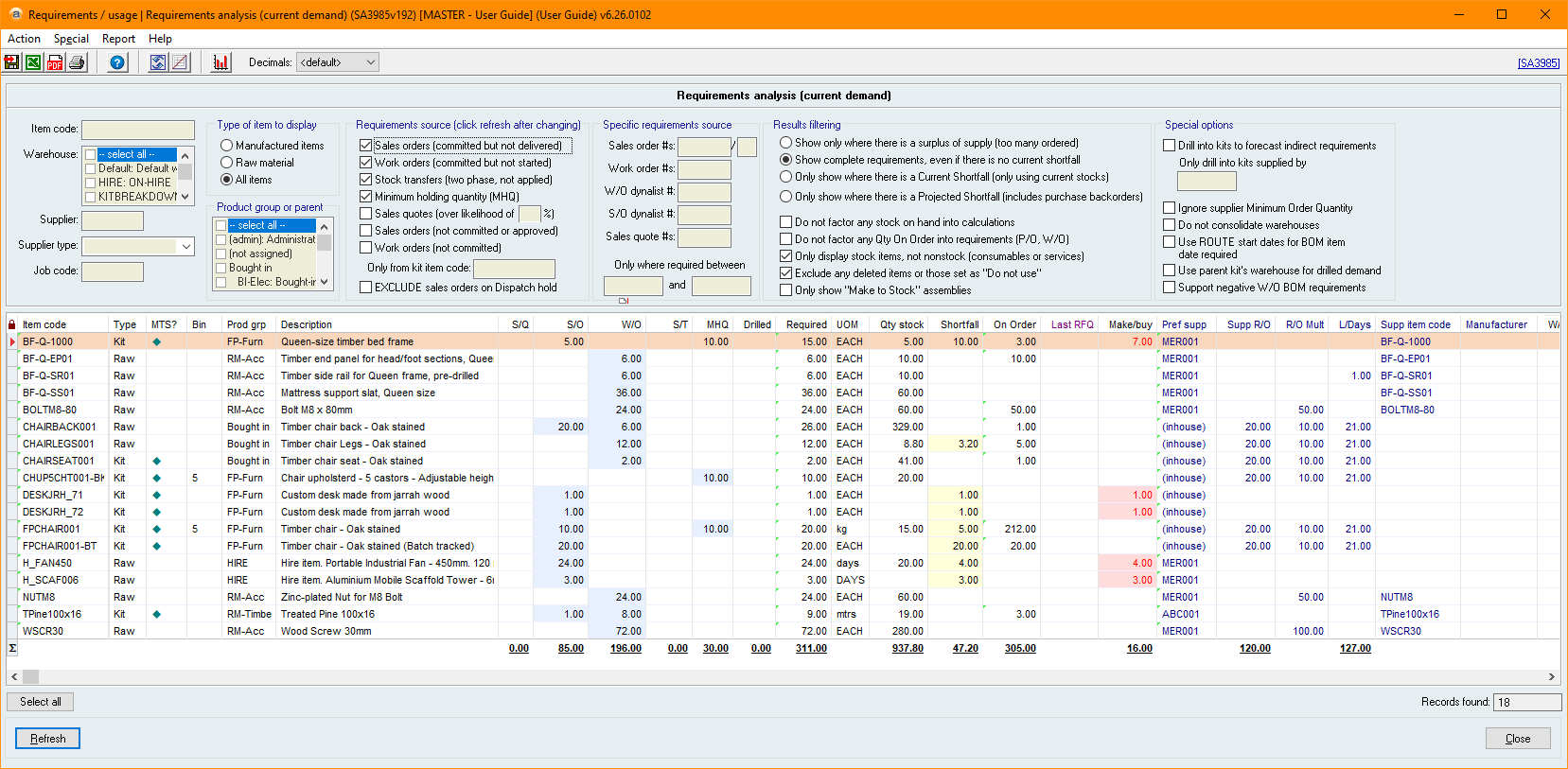
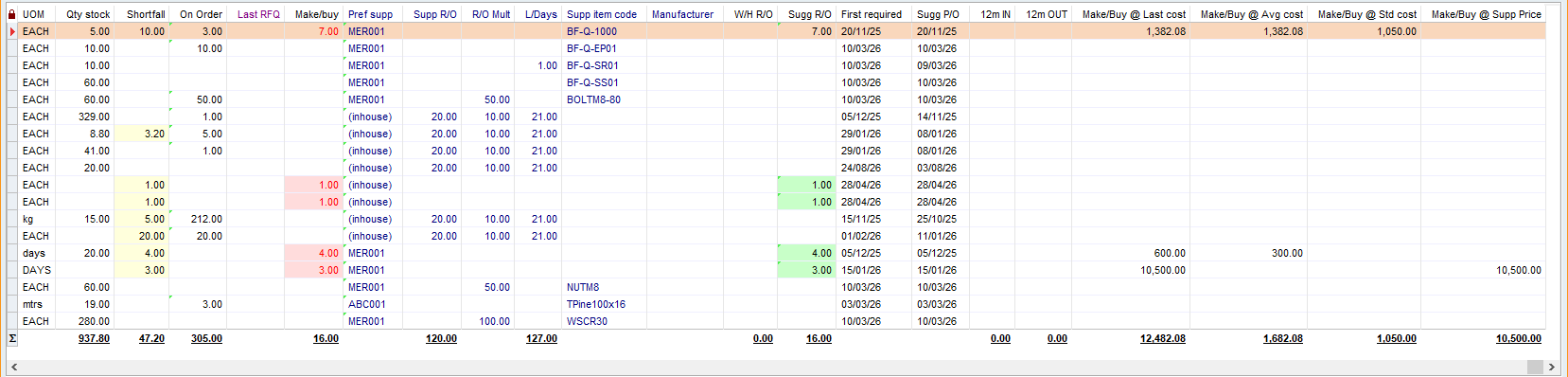
Key filters
 Item code
Filter the resulting required items on the specific item code. This can accept a wildcard *
Warehouse (multi select)
Filter both source and requirements to the warehouse(s) selected. Selection of warehouses here will mean that source requirements are only extracted from the nominated warehouses, and all decisions regarding quantity in stock for requirements processing and quantities on order are also only taken from the nominated warehouses. Take care using this option because incorrectly including or excluding e.g., a bulk store or remote branch warehouse can affect the results
Supplier
Filter the final results to those items supplied by the nominated supplier code where that supplier is also the top ranked supplier for the items. This filter is designed to filter down the results to a supplier for the purposes of selecting all results and creating a purchase order.
Supplier type
Filter final results to those items supplied by the nominated supplier type where suppliers of this type are also the top ranked supplier for the items.
Job code
Filters source data to only those records that are also linked to the nominated job. This filter works in conjunction with all other source data filters and will not specifically include more data than the source requirements call for.
The job code is specific to the type of record source and therefore only applies to Sales orders, Work orders and Sales quotes. A job is not relevant to MHQ or stock transfers so will have no effect when used with these filters.
If you nominate a specific Sales quote in the Specific requirements source, then the Job code filter will be ignored. It will still filter Sales orders and Work orders even if specific Sales order numbers and Work order numbers are provided.
Type of item to display
This option allows you to choose to display either kit items or non-kit items (or both)
Product group or parent
Filters down the final requirements results to only those items belonging to the selected product group(s) or whose parent product is in the selected product groups(s)
Requirements source
This is a key filter and allows you to determine where to look for demand (requirements) for items. This filter allows you to target specific parts of the data to draw out a demand for inventory as follows.
Sales orders (committed but not delivered)
Include demand from all sales order lines that have been committed and not yet delivered.
The sales order will only be committed if the Options on the sales order is set as Approved/Committed and the order has not been cancelled. There are other system settings that determine whether a sales order commits parts or not.
Work orders (committed but not started)
Include demand from the components within any work order that has been committed but where the component itself has not yet been consumed. Typically, this means the work order has not been started, but it can also mean that the parts did not exists in stock when the work order was started and therefore the component has not yet been consumed.
When viewing a work order, the Kit List tab Qty used will show which components have been used (and therefore are no longer part of a demand)
Stock transfers (two phase, not applied)
Include demand from stock transfers that have not been applied. Stock transfers can be designated as “two phase” in the system settings, and it is only two-phase transfers that have not yet been transacted to the second phase that are considered here. Typically, these would be stock transfers that you know are going to happen but have not yet happened and therefore create an expected demand on parts.
Minimum holding quantity (MHQ)
Include demand using the minimum quantity that you say must be held in stock at all times. The MHQ is located on the warehouse tab of each item and is specific to a warehouse for the item. This is a common filter to use for requirements because it allows you to know when you have dropped below your minimums and need to top up your stocks. Note that this is an inclusion to the total demand, which allows you to predict the stock you will need to satisfy other genuine customer or production demands, as well as retaining your safety stock.
Sales quotes (over likelihood of x %)
Include demand from sales quotes that are likely to be won, and therefore predict a future demand of stock. Use this with care: if ordering or production is affected by pending sales quotes that do not eventuate, you may over-order. However, you may benefit from visibility of possible future quote wins for commodity items with long lead times.
Sales orders (not committed or approved)
Include demand from sales orders that have not been committed or approved. This option is mutually exclusive to the sales order option above and allows you to factor in sales orders that are pending or have not been fully committed, but which may be in the future. It is not common to use this filter on a regular basis because it could lead to purchases of products for sales orders which never eventuate, however it is useful to see what ordering may need to happen if they were to be approved. Your business may have a process whereby sales orders that are not yet approved are just awaiting internal approval and are therefore just as valid as approved orders.
Work orders (not committed)
Include demand from work orders that have not been committed. This option is mutually exclusive to the work order option above and allows you to factor in work orders that are pending or have not been fully committed, but which may be in the future.
It is not common to use this filter on a regular basis because it could lead to purchases of products for work orders which never eventuate, however it is useful to see what ordering may need to happen if they were to be committed. Your business may have a process whereby work orders that are not yet committed are just awaiting internal approval and are therefore just as valid as committed orders.
Only from kit code
This special filter allows you to filter source requirements that only originate from a specific item code. This filter is not an additional source, rather a restriction on the sources listed above.
EXCLUDE sales orders on Dispatch hold
Do not take into account any sales orders that are flagged as "Hold dispatches"
Specific requirements source
This special set of filters allows you to target a specific source of requirements, such as a sales order list, or a dynalist of work orders (production schedule). Any data specified in the Special requirements source will override the base requirements to the left even if they have been ticked. This feature allows you to quickly enter a specific record # without having to untick the usual requirements options.
The manner in which the specific requirements sources select data is the same as the base requirements sources and can be considered just like a narrowing down of those sources.
All specific requirements sources produce a combined restriction: all filters will restrict the final results and will not combine to produce an additive result.
Sales order #s
This is a list of sales order numbers. It must be a comma separated list. Any invalid sales orders will be ignored.
Work order #s
This is a list of work order numbers. It must be a comma separated list. Any invalid work orders will be ignored.
W/O dynalist #
This is a dynalist of work order numbers.
S/O Dynalist #
This is a dynalist of sales order numbers.
Sales quote #s
This is a list of sales order numbers. It must be a comma separated list. Any invalid quote numbers will be ignored.
Only where required between X and Y
This is a key filter that allows you to limit the final results to only those items where the requirement data is within the specified date range. Either or both of these dates may be left empty and if so, that relevant filter will not be applied.
The dates on which this filter operates are notes in the column data description and will differ based on the source of the requirement and other filters. This option honours delivery schedule dates from sales orders.
Results filtering
The results filters allow you to restrict the final requirements results based on calculations comparing how much you have in stock and how much is currently already on order.
Show only where there is a surplus of supply (too many ordered)
Only show where the quantity that is on order for the items exceeds the Shortfall. The shortfall is the quantity required less the quantity currently in stock.
Show complete requirements, even if there is no current shortfall
Show the complete requirements generated from the source data, even if there is no current shortfall. You would use this option to verify that no other filtering has excluded items from your data. This option is common in situations where you say “I am sure we needed XYZ, but it is not showing on the report”
Only show where there is a Current Shortfall (only using current stocks)
Show where there is a higher demand for stock than can be met by the current quantities in stock, but not including quantities that are on order through work orders or purchase orders. This option is used when you want a complete list of everything that is short, whether you have plans in place to fix it or not.
Only show where there is a Projected Shortfall (includes purchase backorders)
Show any item where the demand is higher than the supply or both current stocks plus purchase orders and work orders. This is the most common option to say “Show me where there is a problem” because it will highlight any items that have a demand which will not be fulfilled.
The following options apply additional filtering to the options above.
Do not factor any stock on hand into calculations
All calculations currently factor stock on hand into the final calculation for “Shortfall”. However, using this option prevents any current stock on hand from being taken into account. This will generally produce a larger results set and more requirements because all of the calculations will assume that the raw requirements are unable to be offset by current stocks.
Notably, this also affects the operation of drilling into subassemblies: it will be assumed that no subassemblies exist in stock and therefore will be drilled into at every level for the full required quantity (less any quantities on purchase orders or work orders, subject to the option below) of the base requirements.
Do not factor any Qty On Order into requirements (P/O, W/O)
All final calculations currently factor the quantity on outstanding purchase orders or work orders into the final calculation for “Shortfall”. However, using this option prevents any purchase order or work order backorders from being taken into account. This will generally produce a larger results set and more requirements because all of the calculations will assume that the base requirements are not being offset by quantities on order. Notably, this also affects the operation of drilling into subassemblies: it will be assumed that there is no future supply of this stock and therefore will be drilled into at every level (less any quantities in stock subject to the option above) for the full required quantity of the base requirements.
Only display stock items, not nonstock (consumables or services)
Excludes any items from the results that are not set as stock items.
Exclude any deleted items or those set as "Do not use"
Filter results to exclude any resulting items that have been set as “do not use”
Only show "Make to Stock" assemblies
This is a results filter that will only show resulting required items that are also kits (assemblies) and which have been flagged as “Make to order” on the item’s setup tab. This option is useful to isolate production items that are needed for customers.
Special options
Drill into kits to forecast indirect requirements
This is a key option that determines whether or not demand for kits (assembly items) will result in drilling through the kit item to arrive at the raw materials that will be needed to produce that item. When used, the item itself will still be shown as a requirement in the result, as well as all of its components.
When drilling occurs, the item’s bill of materials will be used to determine the components that are required for the item. However, the “Fixed workorder quantity” will not be included (because it is now known how many work orders will be needed or produced).
When determining the quantity of each item that is used to drill at each level, the report will first examine the quantity in stock or on order (subject to the options above for Do not factor any Qty On Order into requirements (P/O, W/O) and Do not factor any stock on hand into calculations, and take only the remaining quantity to drill into components.
For example, say you have a requirement for an A that contains an assembly B.
- This report will examine the requirements of item A, deduct the current quantity in stock and on order, and then use the remaining quantity as the quantity to drill in and find out how many item B’s are needed.
- Then, when drilling into item B, the report will examine how many item B’s are in stock or on order, and then drill into the remainder to get to item C within B.
At each drilling level, the total requirement for each subassembly is analysed, and drilling is performed on the total quantity required of a subassembly based on the base requirements for all of the assemblies which contain that item.
Only drill into kits supplied by
When drilling into subassemblies, this option ensures that drilling is only performed on subassemblies that are supplied by the nominated supplier. This option is typically used to drill into an INHOUSE supplier (i.e., yourself) so that you do not drill into items that are marked as kit items but which you also purchase from a supplier.
Ignore supplier Minimum Order Quantity
This option will instruct the report to ignore the minimum order quantity for the preferred supplier of the item when calculating the quantity for the suggested reorder quantity Sugg R/O. This option is useful if you want to know how much should be ordered regardless of supplier minimums.
Do not consolidate warehouses
This option instructs the report to show results for individual warehouses. Using this option prevents warehouse quantity in stock pooling, which can result in a different suggested reorder quantity when the current quantities in stock are taken from the total of all selected warehouses.
For example, if you have a main warehouse and two branches, and one of the branches has a massive excess of stock, the report may determine that no stock needs to be ordered or made for any warehouse. If, however, your warehouses are treated separately such that you cannot readily transfer stock between them then this option will be important so that you ensure isolation of warehouse quantities.
Use ROUTE start dates for BOM item date required
If specified, then instead of using the work order's scheduled start date to determine the demand date of components on the work order, instead go to the work order kit item's BOM, and examine each part to see if it links to one of the routes on the work order. If it does, then use that route's Scheduled Start for the demand date. If no such route exists that links to the BOM item, then use the earliest scheduled route date that does exist for the work order.
Use parent kit's warehouse for drilled demand
When there is demand for a kit item that has subassemblies, and the Drill into kits to forecast indirect requirements filter is enabled, the warehouse that traditionally registers the demand for each drilled component is the Component warehouse for its corresponding parent kit, because that's where the components would be drawn from by default if a work order was to be created.
However, with this filter enabled, the demand for components of subassemblies is registered against the warehouse from which the original demand for that kit was generated.
If the demand for the kit was generated because the kit was sitting on a sales order, then it will be the sales order Warehouse. But, if the demand for the kit was because that kit was a component of an existing work order in the system, then the parent kit's warehouse is effectively the Stocking warehouse of the kit instead of the component warehouse.
This option is used when you want to see what the requirements would be in a single warehouse without taking into account stocks that may be in separate component warehouses.
Support negative W/O BOM requirements
You may have bills of materials that consume a negative amount of a component. For example, a kit may swap an existing part and effectively 'recover' parts.
By default, this report not mathematically take into account any demand less than 0.
With this filter enabled, it does support negative BOM requirements, meaning you could technically end up with a 'supply'.
Report columns
Item code
The item code that has a demand or requirement. All descriptions below that refer to “the item” refer to this item code.
Type
RAW (any item that is not a kit item / assembly), KIT (a kit item / assembly), N/S (Non-stock item)
MTS?
Is this a make to stock item? This will be the case if the “Make to order” flag on the item has not been ticked (on the Setup tab) and the item is a kit item. This is useful to see whether or not the item should be made in bulk (likely using the MHQ) or individually for each order.
Bin
The highest alphabetical bin location of the item within the warehouse. If you use the filter option Do not consolidate warehouses, then each warehouse and therefore each bin location will be shown.
Prod grp
Product group code of the item
Description
Description from the item card for this item
S/Q
Demand produced from sales quote lines, subject to filters.
S/O
Demand produced from sales order lines, subject to filters. Generally only sales orders that are committed will be shown and the quantity will be the quantity that has not yet been delivered.
S/T
Demand produced from stock transfer lines that have not yet been applied, subject to filters.
W/O
Demand produced from components of a work order that have not yet been consumed, subject to filters. A part on a work order is considered to be “not consumed” if the “Qty used” on the Kit list tab of the work order is less than the “Qty required” for that part.
MHQ
Demand produced from the minimum holding quantity for an item, subject to filters.
Note that the MHQ will still be included even if this option is not ticked, if warehouse quantities are being consolidated and there is any kind of demand for the item. This is to ensure that item demand does not drain MHQ.
Drilled
Total quantity required that has been determined by drilling into the subassemblies of the items which have a genuine demand, subject to the option Drill into kits being set. You may have a quantity in both this column as well as the preceding column where items are both on sales orders as well as included in subassemblies.
The quantity that you see here is subject to the quantity of the subassemblies that are in stock for each subassembly at each level, as explained above in the filter description.
Required
The total quantity of items required (on demand) based on the demand sources.
This is a hyperlink which will pop up a detailed report showing where the requirements have been drawn from including the originating source, and any subassembly drill levels.
UOM
Unit of measure of the item, relative to all of the quantities shown.
Qty stock
Total quantity in stock of the item in either the warehouse shown, or all warehouses selected depending on the filter Do not consolidate warehouses. This quantity does not take into account commitments to orders: it is the actual quantity in stock.
Shortfall
A calculation showing the shortfall between the Required and Qty stock. This is the first quantity that will show you where there is possibly a supply issue.
On order
The quantity of items that are on order through a purchase order (the item is being purchased) or through a production work order (the item is being made). This quantity will display regardless of how you have set Do not factor any Qty On Order into requirements (P/O, W/O).
Last RFQ
The most recent request for quote for this item (Purchase order quote). This indicates if there is still an outstanding P/O quote for the item.
Make/buy
A calculation of how many items the report believes you should make or buy. This is a key figure of the report and is equal to the Shortfall less On order. This will only ever be a positive quantity.
Pref supp
The preferred (#1 rank) supplier for the item
Supp R/O
The supplier’s reorder quantity (shown on the supplier form as Minimum order quantity).
R/O mult
Supplier’s reorder multiple. This is important to know in case a supplier insists that goods must be purchase in, say, lots of 100.
L/Days
Lead time days for this part from the preferred supplier.
Supp item code
Preferred supplier’s item code for this part.
Manufacturer
Manufacturer information for this item for the preferred supplier.
W/H R/O
Warehouse recommended reorder quantity for this item.
Sugg R/O
A calculation showing the suggested quantity that needs to be reordered based on all of the data. This is a key field and is equal to the highest quantity of Make/Buy, Supp R/O and W/H R/O, and also takes into account the supplier’s reorder multiple.
First required
This is the earliest date that the item is required based on the base requirements (even if the quantity is the result of drilling into a kit item from base requirements). The date shown here will depend on the source of the requirements as follows:
Sales order
If the sales order line from which the requirement is drawn has a delivery schedule, then the date of each delivery that has not been fulfilled will be used. This will technically result in multiple individual requirements but will finally be consolidated into a single item. However, if the filter Only where required between X and Y is set, the individual sales order schedule lines may be filtered out producing only the remaining quantity that is required between the dates.
Work order
If the filter Use ROUTE start dates for BOM item date required has been ticked, then the date required will use the route date from the route that is linked to the work order component on the base item’s Bill of Materials management. For example, if a work order contains a component A, and in the bill of materials form (on the Item form) for kit item shows that this component is linked to a specific route code, then the date will be drawn from that linked route code. If the component does not have a direct link to a route, then the earliest date from all routes will be used as the date required for the item.
If the filter Use ROUTE start dates for BOM item date required has not been ticked, then the date will be the work order’s Date required.
Sugg P/O
A calculated field showing the suggested purchase order date, which is the Date required from above, less the preferred supplier’s lead time for that part.
12m IN
The total stock transaction quantity for this item for all stock transactions typically classified as an “IN” transaction. See SA2356 and the column Stock change.
12m OUT
The total stock transaction quantity for this item for all stock transactions typically classified as an “OUT” transaction. See SA2356 and the column Stock change.
Make/Buy @ Last cost
A calculation of the Make/Buy column multiplied by the last cost of the item as shown on the front screen of the item form.
Make/Buy @ Avg cost
A calculation of the Make/Buy column multiplied by the average cost of the item as shown on the front screen of the item form.
Make/Buy @ Std cost
A calculation of the Make/Buy column multiplied by the standard cost of the item as shown on the front screen of the item form.
Make/Buy @ Supp price
A calculation of the Make/Buy column multiplied by the preferred supplier’s cost price of the item. The supplier’s cost is converted to the item’s base UOM and local currency.
Special actions you can take with data on this report
- Highlight one or more lines and use the Action menu to
- Create work orders
- Create purchase orders
- Transfer stock
Last edit: 24/08/2026